
Conflict Awareness and Personal Safety (CAPS)
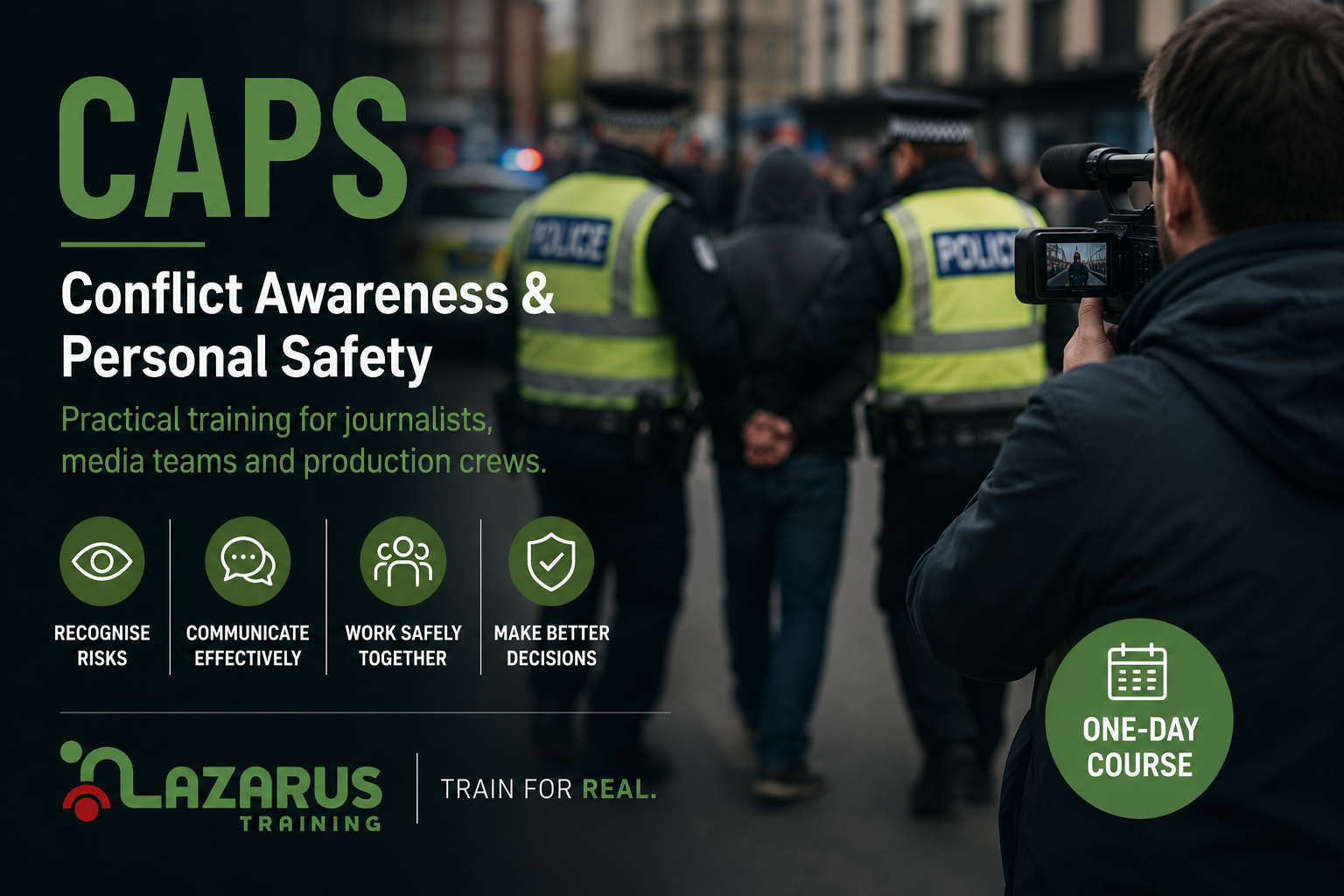
Practical Personal Safety Training for Journalists, Media Teams and Production Crews
Whether you’re filming on location, interviewing contributors, covering public events or travelling to unfamiliar environments, every assignment carries an element of risk. Most incidents don’t occur because journalists deliberately seek danger—they happen because situations change quickly, warning signs are missed or crews find themselves dealing with conflict they never expected.
Conflict Awareness and Personal Safety (CAPS) is a one-day practical safety course designed specifically for journalists, television production teams, documentary crews, photographers and other media professionals working outside controlled environments.
Rather than focusing on survival in war zones, CAPS develops the everyday skills that help people recognise risk earlier, make better decisions and work more safely wherever the story takes them.
Why Media Organisations Choose CAPS
Not every assignment requires a four or five-day Hostile Environment Awareness Training (HEAT) course.
However, many journalists and production teams regularly work in environments where they may encounter:
- Public demonstrations and protests
- Aggressive or confrontational behaviour
- Lone working
- Unfamiliar communities
- Fast-moving public events
- Election coverage
- Road travel in unfamiliar locations
- Heightened political or social tension
CAPS bridges the gap between standard workplace health and safety training and specialist hostile environment courses.
The emphasis is on prevention rather than reaction.
Participants learn how to identify developing risks, recognise behavioural indicators, communicate effectively, de-escalate confrontation where appropriate and make sound decisions before situations become emergencies.
Designed Specifically for the Media
Unlike generic personal safety courses, CAPS has been developed around the realities of modern journalism and media production.
Throughout the course we use realistic media scenarios based on assignments such as:
- Filming in public places
- Doorstep interviews
- Covering demonstrations
- Documentary production
- Working with contributors in unfamiliar areas
- Travelling between filming locations
- Reporting from communities experiencing tension or unrest
The aim is not to teach security tactics or military procedures.
It is to help media professionals continue doing their job safely and confidently.
Course Content
Topics typically include:
Situational Awareness
Developing the ability to recognise changes in your environment, identify emerging risks and make informed decisions before problems escalate.
Conflict Awareness
Understanding how conflict develops, recognising behavioural warning signs and avoiding unnecessary confrontation.
Dynamic Risk Assessment
Simple decision-making tools that can be applied before and during assignments as circumstances change.
Personal Safety
Practical techniques for maintaining personal safety while filming, interviewing or travelling.
Communication and Teamworking
Improving communication within crews and recognising when concerns should be escalated.
Assignment Planning
Preparing for location work through better planning, information gathering and contingency thinking.
Immediate Incident Response
Knowing what to do following an incident, including casualty priorities, communications and obtaining assistance.
Practical, Scenario-Based Learning
CAPS follows Lazarus Training’s Train for Real philosophy.
Rather than relying on lengthy classroom presentations, participants learn through discussion, practical exercises and realistic scenarios based on genuine media assignments.
The focus is on developing judgement and confidence rather than memorising procedures.
By the end of the course, participants should feel better prepared to recognise risk, communicate effectively and make sound operational decisions wherever they are working.
Who Should Attend?
CAPS has been designed for:
- Journalists
- Broadcast crews
- Television production teams
- Documentary filmmakers
- Camera operators
- Photographers
- Producers
- Researchers
- Editors
- Communications teams
- NGO media staff
- Freelance journalists
No previous safety training is required.
Why Choose Lazarus Training?
Lazarus Training has extensive experience delivering operational safety, medical and hostile environment training to media organisations, NGOs, government agencies and international organisations.
Our instructors combine backgrounds in operational medicine, emergency services, policing and the military with extensive experience teaching civilian professionals.
Most importantly, we understand that journalists are not security professionals.
The training reflects the realities of modern journalism, helping participants continue gathering accurate, independent reporting while managing risk effectively.
Looking for More Advanced Training?
CAPS is often the first stage of a wider media safety programme.
Organisations requiring additional capability may also be interested in:
Field Integrity and Resilience for Media (FIRM) — our flagship operational safety programme covering surveillance awareness, digital security, assignment planning, organisational resilience and working in higher-risk environments.
Hostile Environment Awareness Training (HEAT) — for teams deploying into conflict zones or other hostile environments.
First Aid in Remote Locations (FARL) — advanced first aid training for media professionals working where emergency medical support may be delayed.
Talk to Us
If your organisation would like to improve the safety of journalists, production teams or field crews, we’d be pleased to discuss how CAPS can be tailored to your operational requirements.
Whether you require training for a single production team or an organisation-wide programme, we can deliver practical, evidence-informed training designed around the environments in which your people actually work.