
Medical Emergencies in the Dental Practice
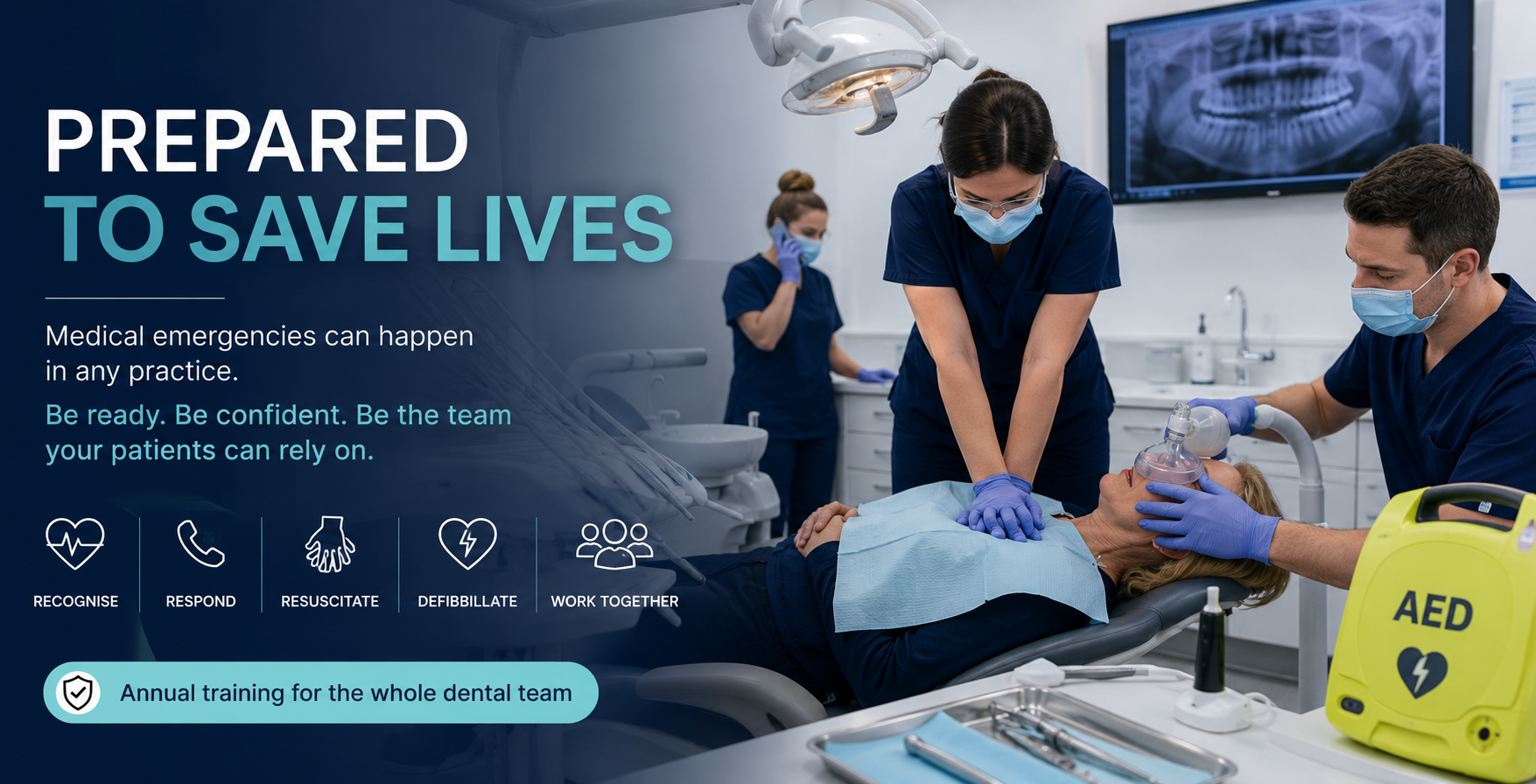
Annual practical training for the whole dental team
Medical emergencies can happen without warning. When they do, every member of the dental team needs to understand their role, recognise what is happening and respond confidently until further medical assistance arrives.
Lazarus Training’s Medical Emergencies in the Dental Practice course provides the practical annual update recommended for dental professionals and practice teams.
The programme combines current guidance, hands-on skills and realistic practice-based scenarios. It is designed specifically for dental settings rather than being a generic workplace first aid course.
Why dental teams need annual training
The General Dental Council requires dental professionals to follow the medical emergency and training guidance issued by Resuscitation Council UK. All dental professionals must be trained to deal with medical emergencies, including resuscitation, and must retain current evidence of their competence.
Resuscitation Council UK recommends that dental practitioners and other dental healthcare staff update their resuscitation knowledge and practical skills at least annually. The GDC also recommends at least two hours of medical-emergency CPD each year, contributing towards a recommended ten hours during each CPD cycle.
Training should not only confirm that individuals can perform basic life support. It should help the whole practice team work together effectively during an emergency.
Who should attend?
This course is suitable for the full dental practice team, including:
- Dentists
- Dental nurses
- Dental hygienists
- Dental therapists
- Orthodontic therapists
- Practice managers
- Reception and administrative staff
- Other team members who may be present when an emergency occurs
Every person’s role will be different, but all team members should understand how to recognise an emergency, raise the alarm, assist with treatment and support an effective team response.
What the course covers
The programme is adapted to the needs, equipment and working arrangements of the dental practice.
Recognising and responding to an emergency
Participants review how to:
- Recognise a seriously ill or deteriorating patient
- Conduct an immediate structured assessment
- Summon appropriate assistance
- Call the emergency services and provide clear information
- Allocate roles within the practice team
- Prepare for the arrival of ambulance personnel
- Record and report the incident appropriately
Basic life support and defibrillation
Practical training includes:
- Recognising cardiac arrest
- Adult cardiopulmonary resuscitation
- Use of an automated external defibrillator
- CPR in and around the dental chair
- Managing space and access within the surgery
- Effective team working during resuscitation
- Safe handover to the ambulance service
Where appropriate to the practice, paediatric considerations can also be included.
Airway and oxygen skills
Participants practise:
- Opening and maintaining an airway
- Recovery-position considerations
- Management of choking
- Use of available airway equipment
- Oxygen administration
- Familiarisation with the practice’s oxygen equipment
- Safe use of barrier devices and resuscitation equipment
Medical emergencies encountered in dental practice
The course can include recognition and initial management of:
- Vasovagal syncope
- Cardiac arrest
- Angina and suspected myocardial infarction
- Anaphylaxis
- Asthma
- Hypoglycaemia
- Epileptic seizures
- Choking and airway obstruction
- Stroke
- Adrenal crisis
- Other emergencies identified through the practice risk assessment
The emphasis is on recognising the problem, providing immediate care, using the equipment and medicines available within the practice, and obtaining appropriate further assistance.
Emergency medicines and equipment
Training includes practical familiarisation with the practice’s emergency arrangements, including:
- Location of emergency medicines and equipment
- Individual and team responsibilities
- Indications for the principal emergency medicines
- Preparation and assistance with administration
- Oxygen and AED availability
- Routine equipment checks
- Monitoring expiry dates and replacements
- Maintaining immediate access during an emergency
CQC guidance expects emergency medicines and equipment to be readily accessible, centrally located and known to the team. The availability and management of this equipment may be considered when assessing whether a practice is safe.
Realistic dental-practice scenarios
Medical-emergency skills are difficult to retain through presentation-based learning alone.
Our training uses realistic scenarios to help teams apply their skills in the places where emergencies may actually occur.
Scenarios may include:
- A patient becoming unresponsive in the dental chair
- A cardiac arrest during treatment
- Anaphylaxis following the administration of a medicine
- A patient collapsing in reception
- Hypoglycaemia during a prolonged procedure
- A child experiencing a seizure
- An asthma attack during treatment
- A choking patient
- Managing an emergency with limited space and equipment
Scenarios examine more than clinical skills. They also test communication, leadership, role allocation, access to equipment, contacting the emergency services and receiving the ambulance crew.
The purpose is not to catch people out. It is to identify practical improvements before a real emergency occurs.
Training built around your practice
Every dental practice is different.
The location of equipment, surgery layout, number of team members, patient profile and access to ambulance support can all affect the response.
Where training is delivered at your practice, we can incorporate:
- Your own surgery and reception areas
- Your emergency equipment
- Your internal emergency procedure
- The normal roles of your staff
- Challenges created by room layout or restricted access
- Local risks identified by the practice
This makes the training directly relevant and helps expose problems that may not become apparent during a generic classroom course.
Course duration
The standard programme is normally delivered over approximately four hours.
This allows time for:
- Guidance and knowledge updates
- CPR and AED practice
- Airway and oxygen skills
- Review of common medical emergencies
- Team-based scenarios
- Structured feedback and discussion
A shorter programme may not allow enough time for meaningful practical training across the whole team.
A full-day option is available for organisations wanting more extensive scenario practice, paediatric content or a broader review of their emergency arrangements.
What this course does not cover
This is a focused medical-emergencies update for dental teams. It is not intended to replace separate training required for:
- Conscious sedation
- Advanced or immediate life support qualifications
- Comprehensive workplace first aid
- Major trauma management
- Advanced drug administration
- Intravenous access
- Advanced airway procedures
- Fire safety
- Manual handling
- Infection prevention and control
- Safeguarding
Conscious sedation sits under separate professional guidance and should not be treated as part of a standard dental medical-emergencies update. Resuscitation Council UK’s primary dental care standards do not cover the additional requirements associated with conscious sedation.
The course keeps participants within their expected role and scope of practice. It focuses on the skills the dental team may reasonably be expected to use while awaiting further clinical assistance.
Evidence of training
Participants who successfully complete the programme receive a certificate confirming their attendance and the content covered.
The practice can retain the training record as evidence of its annual update programme. This can support:
- Individual CPD records
- Practice training records
- Staff induction and development
- Quality assurance
- CQC inspection preparation
- Internal governance arrangements
The course can be provided as verifiable CPD, with clear learning objectives, anticipated development outcomes and participant feedback.
Optional Dental Emergency Preparedness Review
Training tells the team what to do. A preparedness review examines whether the practice has made it possible for them to do it.
This optional service can be delivered alongside the training and may consider:
- Accessibility of emergency medicines and equipment
- AED and oxygen arrangements
- Equipment standardisation
- Expiry-date and checking systems
- Staff awareness
- Role allocation
- Emergency-service access
- Practice layout
- Internal procedures
- Findings from team scenarios
The review is not a regulatory inspection. It is a practical examination of how the practice’s people, equipment and procedures work together.
The practice receives a short findings report highlighting strengths, potential gaps and recommended actions.
Why choose Lazarus Training?
Lazarus Training specialises in practical, scenario-based medical training.
Our instructors have backgrounds in emergency care, policing, military medicine, ambulance services and operational training. We focus on helping participants make good decisions and work effectively under pressure rather than simply completing a syllabus.
Our approach includes:
- Current clinical content
- Practical skills development
- Realistic patient scenarios
- Team communication and human factors
- Training adapted to the practice
- Clear and supportive feedback
- Verifiable CPD documentation
Book your annual dental medical-emergency update
We can deliver the course at your dental practice or arrange training for several practices at a central venue.
To discuss your team size, preferred date and training requirements, contact Lazarus Training on 0800 242 5210 or via info@lazarustraining.co.uk
Medical Emergencies in the Dental Practice
Practical annual training for confident, prepared dental teams.