

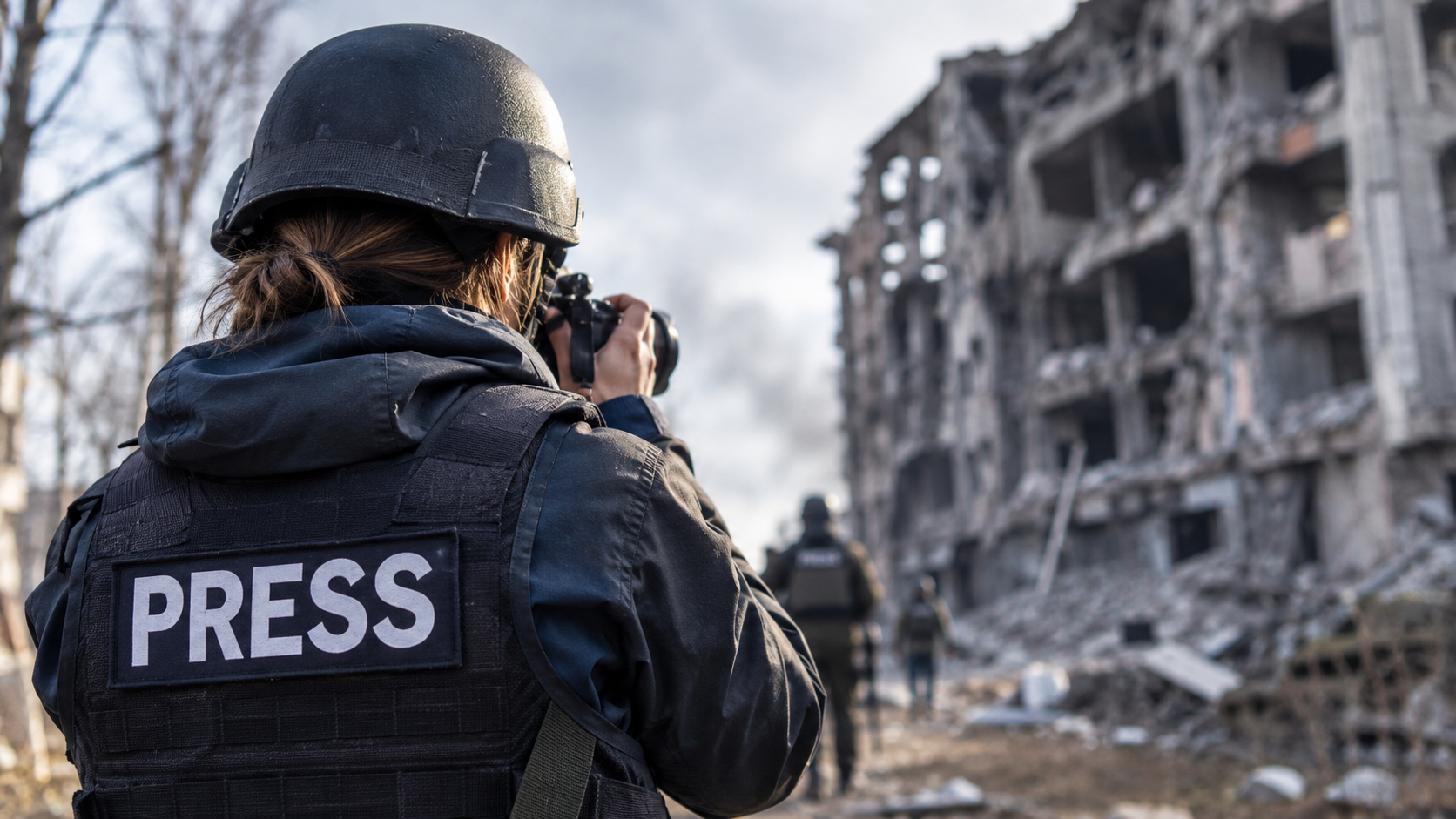
New research from Ukraine highlights significant gaps in journalists’ emergency preparedness, alongside increasing workloads, staff shortages and psychological pressures. The findings raise important questions for media organisations operating in challenging environments worldwide.
How prepared are journalists for the risks they face?
Journalists working in conflict zones, areas of political instability and other challenging environments are often expected to make difficult decisions under pressure. Their work can expose them to violence, civil unrest, detention, surveillance and medical emergencies.
But how well prepared are they to manage these risks?
Research published by Ukraine’s Institute of Mass Information (IMI) in October 2026 provides some concerning insights.
Only 1.9% of surveyed journalists met all four of the study’s emergency preparedness criteria.
The research also identified significant challenges relating to safety equipment, practical preparedness, staffing and psychological wellbeing.
These findings deserve attention well beyond Ukraine. They raise a fundamental question for media organisations everywhere: are we giving journalists the skills, resources and support they need to work safely?
Having safety equipment is not the same as being prepared
One particularly striking finding concerned emergency medical preparedness.
The survey reported that just 15.1% of respondents regularly carried tourniquets, raising questions about access to appropriate medical equipment and preparedness to manage life-threatening bleeding.
A tourniquet can be lifesaving in cases of severe limb bleeding. However, simply issuing medical equipment does not mean that an individual can use it correctly, particularly under extreme stress.
The same principle applies to other aspects of personal safety.
A journalist may have a protective helmet and body armour but lack the knowledge to assess whether entering a particular location is justified. They may have emergency communications equipment but no effective communications plan. They may have completed a risk assessment without having rehearsed what to do when circumstances change.
Equipment is important, but equipment without training, planning and practice offers only limited protection.
Effective preparation requires journalists to understand the risks they face, recognise changes in their environment and respond appropriately when an incident occurs.
Training must reflect the environment
Not all challenging environments present the same threats, and journalist safety training must reflect those differences.
For journalists operating in active conflict zones, such as Ukraine, Hostile Environment Awareness Training (HEAT) provides preparation for the serious risks associated with warfare.
These may include artillery and missile attacks, mines and unexploded ordnance, armed violence, movement through insecure areas and severe traumatic injuries.
Lazarus Training has delivered HEAT programmes in the context of the war in Ukraine, helping participants develop the practical skills and decision-making abilities needed to recognise and manage threats in hostile environments.
Our approach places particular emphasis on realistic, scenario-based learning. Participants have opportunities to practise risk assessment, emergency responses, communications and medical skills under controlled pressure.
However, not every journalist faces the same level or type of risk.
A reporter covering politically sensitive elections, a documentary team working in a remote location or a journalist investigating organised crime may face serious threats without operating in an active war zone.
For these environments, Lazarus Training’s Field Integrity and Resilience for Media (FIRM) programme offers a more tailored approach.
FIRM addresses the practical challenges of reporting in difficult or potentially dangerous environments, including personal safety, threat recognition, assignment planning, situational awareness, emergency preparedness and resilience.
The objective is not to make journalists more willing to take risks. It is to help them understand those risks, make informed decisions and recognise when an assignment has become unsafe.
Whether through HEAT, FIRM or a bespoke programme, training should be relevant to the actual operational environment and the responsibilities of those attending.
Journalist safety is also a newsroom responsibility
Perhaps the most important lesson from the Ukrainian research is that individual preparedness cannot be separated from organisational resilience.
The survey identified substantial staffing difficulties across Ukrainian newsrooms:
- 38.5% reported heavy reliance on just one or two individuals.
- 28.7% struggled to fill important positions.
- 49.1% of journalists reported increased workloads.
- 56.6% of media teams experienced burnout.
These pressures can have direct consequences for safety.
A journalist working excessive hours may experience fatigue, reduced concentration and impaired decision-making. An understaffed newsroom may struggle to provide effective monitoring, emergency support or adequate preparation before an assignment.
Where resources are limited, training and safety arrangements may be among the first activities to be postponed.
Yet these are often the circumstances in which effective safety systems are most important.
Media organisations should consider whether they have clear processes for assignment risk assessments, communications, incident management, medical emergencies and staff welfare.
They should also ensure that managers and editors understand their responsibilities when commissioning work in challenging environments.
Journalist safety cannot depend entirely on the individual journalist. It must be supported by the organisation sending them into the field.
The psychological impact of working in challenging environments
The survey also highlighted the psychological pressures facing Ukrainian journalists.
It found that 56.6% of media teams experienced burnout, while only 14.7% had access to professional psychological support.
These figures are particularly concerning given the prolonged exposure to conflict, uncertainty and personal danger experienced by many Ukrainian media workers.
However, psychological pressures are not confined to war reporting.
Journalists covering violent crime, civil unrest, disasters, humanitarian emergencies or traumatic events may encounter significant emotional demands.
Organisations should recognise that resilience is not simply about an individual’s ability to cope. It also depends on workloads, leadership, peer support, access to appropriate professional assistance and a working environment in which people can raise concerns without stigma.
Safety training can help journalists recognise stress responses and understand practical strategies for managing pressure. However, training should complement, rather than replace, appropriate organisational welfare arrangements and professional mental health support.
Building a stronger culture of journalist safety
The findings from Ukraine reinforce the need for media organisations to take a comprehensive approach to journalist safety.
This should include:
- Risk assessment and assignment planning: Ensuring threats are identified, assessed and reviewed as circumstances change.
- Appropriate practical training: Matching HEAT, FIRM or other specialist preparation to the actual threats faced.
- Emergency medical preparedness: Ensuring personnel have appropriate equipment and the skills to use it.
- Emergency communications and incident management: Establishing clear procedures for maintaining contact, reporting incidents and coordinating assistance.
- Organisational preparedness: Ensuring editors, managers and support teams understand their roles in protecting staff and freelancers.
- Psychological wellbeing: Recognising the cumulative impact of exposure to traumatic events and providing appropriate support.
- Continuous learning: Reviewing incidents, identifying lessons and adapting training and procedures to emerging risks.
There is no single training package or equipment list that will meet every requirement.
Effective preparation starts with understanding the environment, the assignment and the people involved.
Supporting journalists and media organisations worldwide
Lazarus Training has extensive experience delivering medical, safety and security training internationally, including HEAT programmes supporting operations in the context of Ukraine and specialist FIRM training for media professionals working in challenging environments.
Our programmes can be tailored to the operational environment, experience and needs of individual organisations.
We recognise that journalists need to continue doing their jobs. Effective safety training should support that work, not create unnecessary barriers to reporting.
The aim is to help journalists and their organisations recognise threats, manage risks, respond effectively to emergencies and develop the confidence to make informed decisions.
The Ukrainian research is a reminder that preparedness cannot be assumed, even among people who work in dangerous environments regularly.
Experience is valuable, but experience alone is not a substitute for structured preparation, practical skills and organisational support.
For media organisations, investing in journalist safety is not simply a matter of meeting a training requirement. It is an investment in their people, their operational resilience and their ability to continue reporting when it matters most.
How Lazarus Training can help
Whether preparing journalists for conflict environments through HEAT, supporting media teams through FIRM or developing bespoke programmes for specific operational challenges, Lazarus Training can help organisations strengthen their safety arrangements.
Contact us to discuss your organisation’s training requirements.
Source: Institute of Mass Information (Ukraine), October 2026. Research into journalist safety preparedness and staffing challenges, reported by Inkorr.