
SAFE and SAFE+ Training
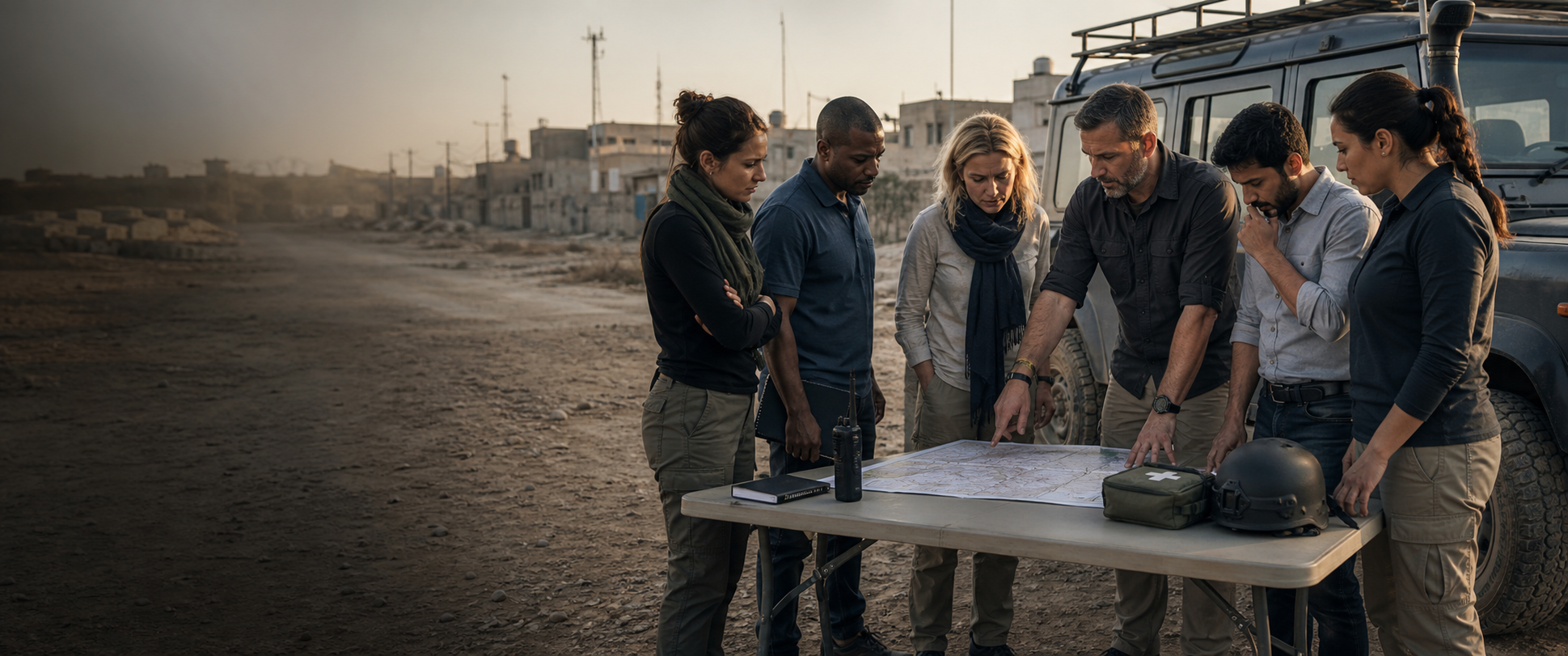
Security Awareness in Fragile Environments
Lazarus Training provides SAFE and SAFE+ training for organisations whose personnel may work, travel or deploy in fragile, complex, remote or higher-risk environments.
Our programmes combine security awareness, practical decision-making and emergency medical skills. Training can be configured around an organisation’s operating environment, risk profile, duty-of-care responsibilities and deployment procedures.
SAFE and SAFE+ courses are suitable for government personnel, international organisations, NGOs, humanitarian and development agencies, healthcare teams, journalists, researchers, contractors and businesses operating internationally.
What is SAFE training?
SAFE—Security Awareness in Fragile Environments—is practical pre-deployment training for people who may be exposed to increased levels of crime, political instability, civil unrest, terrorism, disrupted infrastructure or limited local support.
The course helps participants understand the environment in which they will be working, recognise developing threats and take proportionate action to protect themselves and those around them.
Rather than concentrating solely on worst-case incidents, SAFE training begins with prevention. Participants learn how preparation, situational awareness, communication and sound everyday decisions can reduce their exposure to risk.
Classroom learning is supported by discussion, practical exercises and realistic scenarios. This allows participants to practise making decisions while dealing with uncertainty, incomplete information and changing circumstances.
What may a SAFE course cover?
Course content is agreed with the commissioning organisation and may include:
- Understanding fragile and complex environments
- Personal security and situational awareness
- Threat and vulnerability assessment
- Preparing for overseas travel and deployment
- Individual and team security planning
- Journey management and movement security
- Vehicle, hotel, accommodation and workplace security
- Communications, check-in procedures and incident reporting
- Crime prevention and responding to criminal activity
- Conflict management and de-escalation
- Cultural awareness and appropriate personal conduct
- Civil unrest, demonstrations and public disorder
- Terrorism awareness
- Checkpoints, roadblocks and encounters with armed personnel
- Awareness of weapons, explosives and unexploded ordnance
- Emergency actions, contingency planning and evacuation
- First aid and casualty management where help may be delayed
- Personal resilience, stress and post-incident considerations
The precise balance of security, medical and practical content can be adapted to the participants’ roles, experience and anticipated operating environment.
What is SAFE+?
SAFE+ extends the principles introduced during SAFE training for personnel facing higher or more complex levels of risk.
It is intended for organisations that require additional preparation for hostile incidents, deteriorating security conditions or deployments where conventional emergency assistance may not be immediately available.
Depending upon the commissioning organisation’s requirements, SAFE+ may include:
- Responding to gunfire, explosions and indirect fire
- Actions during rapidly developing security incidents
- Use and limitations of personal protective equipment
- Enhanced movement and journey-security procedures
- Hibernation, relocation and evacuation planning
- Detention, arrest, abduction and captivity awareness
- Operating around armed security personnel
- Coordinated team responses and communications
- Enhanced trauma care in dangerous or resource-limited environments
- Complex, immersive and multi-stage scenarios
SAFE+ can be delivered as an extension to a SAFE programme, as refresher training or as a separately configured course for personnel with previous security-awareness experience.
Security and medical skills brought together
A serious incident in a fragile environment rarely presents only one problem. A security threat may cause casualties; a medical emergency may create additional security risks; communications and transport may be disrupted; and outside assistance may be delayed.
Lazarus Training brings security decision-making and emergency medical response together. Participants consider not only how to provide immediate care, but whether it is safe to approach, how to protect the team, when to move a casualty and how to obtain further assistance.
This integrated approach helps participants develop practical responses that reflect the realities of working beyond normal emergency-service support.
Scenario-based learning
Knowledge must remain usable when people are tired, uncertain or under pressure. Our practical exercises are designed to help participants:
- Recognise important changes in their surroundings
- Communicate clearly during an incident
- Make proportionate decisions with limited information
- Apply organisational procedures in realistic circumstances
- Work effectively as part of a team
- Review their decisions and identify lessons
- Develop confidence without encouraging unnecessary risk-taking
Scenarios are controlled, risk assessed and supported by structured briefings and debriefings. Training is intended to challenge participants constructively while maintaining an appropriate learning environment.
Courses designed around the organisation
SAFE and SAFE+ requirements vary considerably. A short-term technical visitor will face different challenges from a resident country team, humanitarian responder, healthcare specialist, journalist or senior manager.
Before delivery, we can work with the commissioning organisation to consider:
- Countries and regions of operation
- Participant roles and experience
- Anticipated threats and vulnerabilities
- Existing security policies and travel procedures
- Medical provision and evacuation arrangements
- Training duration and participant numbers
- Required balance between classroom and practical activity
- Accessibility, welfare and reasonable adjustments
- Assessment, reporting and refresher requirements
Training can support an organisation’s wider travel-risk management and duty-of-care arrangements. It does not replace current country information, professional security advice or the organisation’s own security and crisis-management procedures.
Who should attend?
SAFE and SAFE+ training may be appropriate for:
- Personnel deploying or travelling to fragile environments
- Humanitarian and international-development staff
- Government and public-sector personnel
- Medical and public-health teams
- Journalists, researchers and documentary teams
- Engineers, consultants and technical specialists
- Security, logistics and operations personnel
- Managers responsible for travelling or deployed staff
- Contractors supporting international programmes
Course entry requirements, medical considerations and any prerequisite experience are agreed during programme design.
Procurement and tender enquiries
Lazarus Training welcomes enquiries from organisations procuring SAFE, SAFE+, hostile-environment, travel-safety and associated medical training.
We can respond to requests for information, preliminary market engagement, requests for quotation, framework opportunities and formal invitations to tender.
Subject to the requirements of the procurement exercise, supporting information can include:
- Proposed course structures and learning outcomes
- Trainer competence and relevant experience
- Quality-assurance arrangements
- Scenario and exercise safety management
- Medical and welfare provision
- Delivery capacity and proposed locations
- Equipment and training-resource requirements
- Assessment and participant feedback arrangements
- Insurance and organisational documentation
- Pricing and implementation schedules
To discuss a forthcoming requirement or invite Lazarus Training to participate in a procurement exercise, please contact us.
Frequently asked questions
Is SAFE the same as HEAT?
The terms SAFE and Hostile Environment Awareness Training—HEAT—are sometimes used for courses addressing related risks. Requirements and course content vary between organisations. Lazarus Training will review the commissioning organisation’s specification and propose a programme appropriate to the required outcomes rather than relying on a course title alone.
Can SAFE training be tailored to a particular country?
Yes. Where appropriate, scenarios and discussions can reflect the anticipated operating environment. Country-specific material must be based on current information and should complement the commissioning organisation’s professional security advice and pre-deployment briefings.
Does the course include first aid?
Medical content can be incorporated according to the required outcomes. This may range from an immediate-response refresher to more extensive casualty assessment, trauma care and decision-making where evacuation or professional help may be delayed.
Can SAFE+ be delivered as a refresher?
Yes. SAFE+ or selected course elements can be configured for participants who have previously completed security-awareness or hostile-environment training. Existing competence and the time elapsed since previous training should be considered during programme design.
Where can training be delivered?
Delivery arrangements depend upon the required facilities, practical exercises, participant numbers and risk-management measures. Lazarus Training can discuss suitable client-site, external-venue or dedicated training-location options during the procurement process.
How do we request tender information?
Contact Lazarus Training via info@lazarustraining.co.uk with a brief description of the requirement, anticipated participant numbers, proposed delivery period and procurement timetable. We can then confirm our interest and provide the appropriate organisational or tender information.