

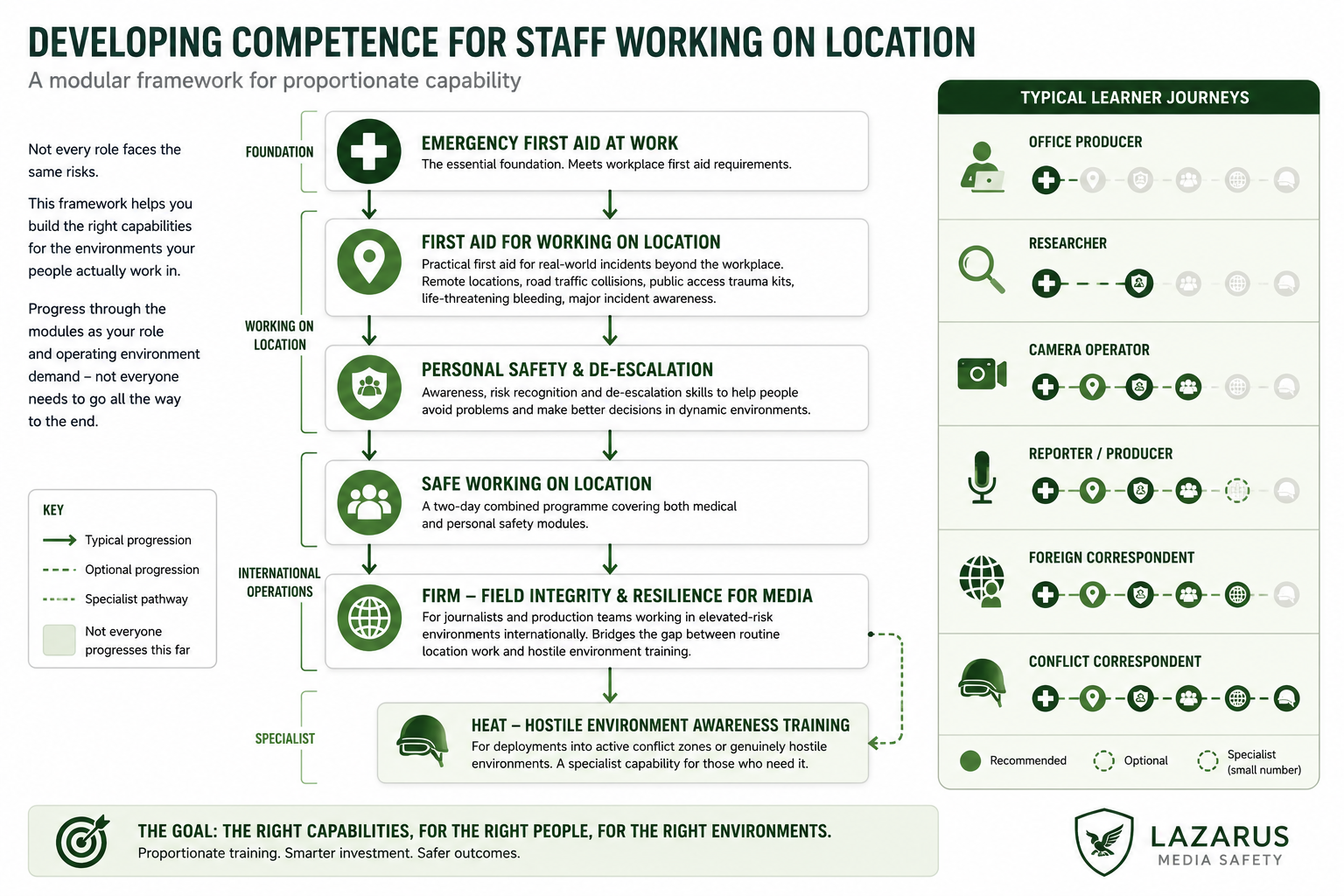
Developing competence for staff working on location
Media organisations have never faced greater pressure to do more with less.
Training budgets are under increasing scrutiny, and organisations quite rightly focus first on mandatory compliance. At the same time, journalists, producers, camera operators and production teams continue to work in dynamic and unpredictable environments every day.
This raises an important question.
Are we giving people the right training for the work they actually do?
Compliance isn’t the same as operational competence
Emergency First Aid at Work (EFAW) provides an excellent foundation and remains an essential workplace qualification.
At the other end of the spectrum, Hostile Environment Awareness Training (HEAT) prepares staff for deployment into conflict zones and genuinely hostile environments.
But what about everyone in between?
Many media professionals regularly work:
- at demonstrations and protests
- in busy public spaces
- at major sporting and entertainment events
- following road traffic collisions
- at industrial incidents
- in remote rural locations
- during severe weather
- alongside the emergency services
- with distressed or confrontational members of the public
These situations don’t necessarily justify a full HEAT course.
Equally, they often require skills that extend beyond a standard workplace first aid qualification.
We believe there is an opportunity to bridge that gap.
A different way of thinking
Rather than asking:
“What course should this person attend?”
perhaps we should ask:
“What capabilities does this role require?”
Every member of a production team faces different challenges.
An office-based producer has different training requirements to a camera operator covering breaking news.
A researcher working occasionally on location faces different risks to an investigative journalist protecting confidential sources overseas.
Not everyone needs the same training.
Introducing the Working on Location Framework
At Lazarus Training we’re developing a modular competency framework designed specifically for people working on location.
The concept is simple.
Provide the right capability to the right people, based on the environments in which they actually work.
Potential modules include:
Emergency First Aid at Work
Providing the nationally recognised workplace first aid qualification.
First Aid for Working on Location
Building on EFAW with realistic operational scenarios including:
- remote incidents
- road traffic collisions
- environmental emergencies
- delayed emergency service response
- Public Access Trauma Kits
- responding to life-threatening bleeding
- major incident awareness
Personal Safety & De-escalation
Helping staff:
- recognise developing risks
- improve situational awareness
- make better decisions under pressure
- work safely around demonstrations and public events
- use effective verbal de-escalation
- disengage safely when situations change
Safe Working on Location
A combined programme bringing together medical and personal safety skills for staff who regularly work in dynamic environments.
Working on Location Manager
Supporting editors, assignment managers and producers responsible for planning deployments and exercising duty of care.
Beyond working on location
For organisations whose staff deploy internationally, we believe there is a further step.
Our Field Integrity & Resilience for Media (FIRM) programme has been developed for journalists and media professionals operating in elevated-risk environments.
Rather than focusing solely on hostile environments, FIRM addresses the broader realities of international journalism, including:
- surveillance awareness
- protecting confidential sources
- personal security
- digital security
- civil unrest
- movement planning
- operational medical response
- decision making under pressure
For those deploying into active conflict zones or genuinely hostile environments, specialist HEAT training remains an important capability.
We’re looking for your views
This framework is currently being developed following discussions with broadcasters, production companies, journalists and international media organisations.
Before taking it further, we’d like to hear from the industry.
Do these capability gaps reflect your experience?
Would a modular approach help your organisation provide more proportionate training?
Are there skills we’ve overlooked?
If you’re interested in contributing to the discussion, we’d be delighted to share our discussion paper and keep you updated as the framework develops.
Join the conversation
Enter your email below to receive:
- our forthcoming discussion paper
- future updates
- invitations to webinars
- opportunities to contribute to the development of the framework
We’re particularly interested in hearing from broadcasters, production companies, freelance journalists, NGOs, public service media organisations and safety professionals working across the media sector.